
Context-aware pricing & price books built into the commercial workflow
Set pricing by account, customer group, catalog, or store, and apply it consistently across offers and storefront orders.
Product map
Advanced pricing & price books
Product map
Advanced pricing & price books
Pricing infrastructure
Pricing in Reforce is built as a context-aware operating layer where price books, rule types, quantity ranges, validity windows, and configuration-aware conditions shape commercial behavior directly inside offers and orders.
Feature
Pricing & price books
Built for teams that need pricing decisions to depend on account, customer group, catalog, store, and commercial timing.
[/1] Scope
Multi-context
Price books can be scoped to specific accounts, customer groups, catalogs, or stores instead of living as one flat matrix.
[/2] Rule types
4+
Fixed, amount, percent, and formula-based rules let teams model different pricing behaviors precisely.
[/3] Application
Direct
The final price can flow straight into offers and storefront orders without manual rework.
Price books and pricing rules that actually reflect commercial reality
Strong pricing infrastructure is not just about storing values. It is about expressing how pricing changes across account context, quantity, timing, and rule priority.
Pricing is one of the deepest parts of Reforce. Teams can scope price books to accounts, customer groups, catalogs, or stores, and then apply fixed, amount, percent, or formula-based pricing logic based on the commercial context.
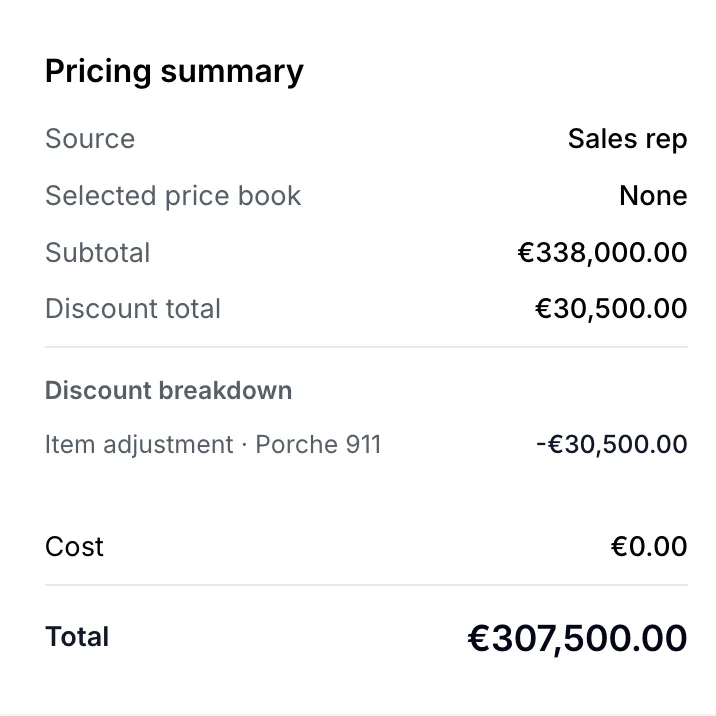
Quantity ranges, priorities, time windows, and offer conditions help teams control which price applies and when. The result flows directly into offers and storefront orders instead of being rebuilt later.
Scoped price books by account, group, catalog, or store
Layered pricing rules with clear priority
Quantity ranges, validity windows, and configuration-aware conditions
Direct pricing output into commercial workflows
Where teams usually feel the impact
Offer consistency
Reps get pricing that reflects the same scoped rules every time instead of rebuilding logic manually.
Storefront parity
External orders can inherit the same pricing structure used in internal offer workflows.
Governance clarity
Teams can inspect which rule applied, why it applied, and when a different rule should take precedence.
See it in action
Make commercial structure easier to launch
Use Reforce to connect catalogs, configuration, pricing, and customer execution in one workflow teams can actually trust.